
A patient of mine — let's call him Mr Lim — once quietly stopped taking his prescription because his family laughed at one ingredient on the label: 当归 (dang gui). "That's for women lah!" they said. Weeks later, he was still pale, dizzy, and tired. The herbs sat unopened on his kitchen counter.
This is one of the most common misconceptions I meet in clinic, and it is worth correcting.
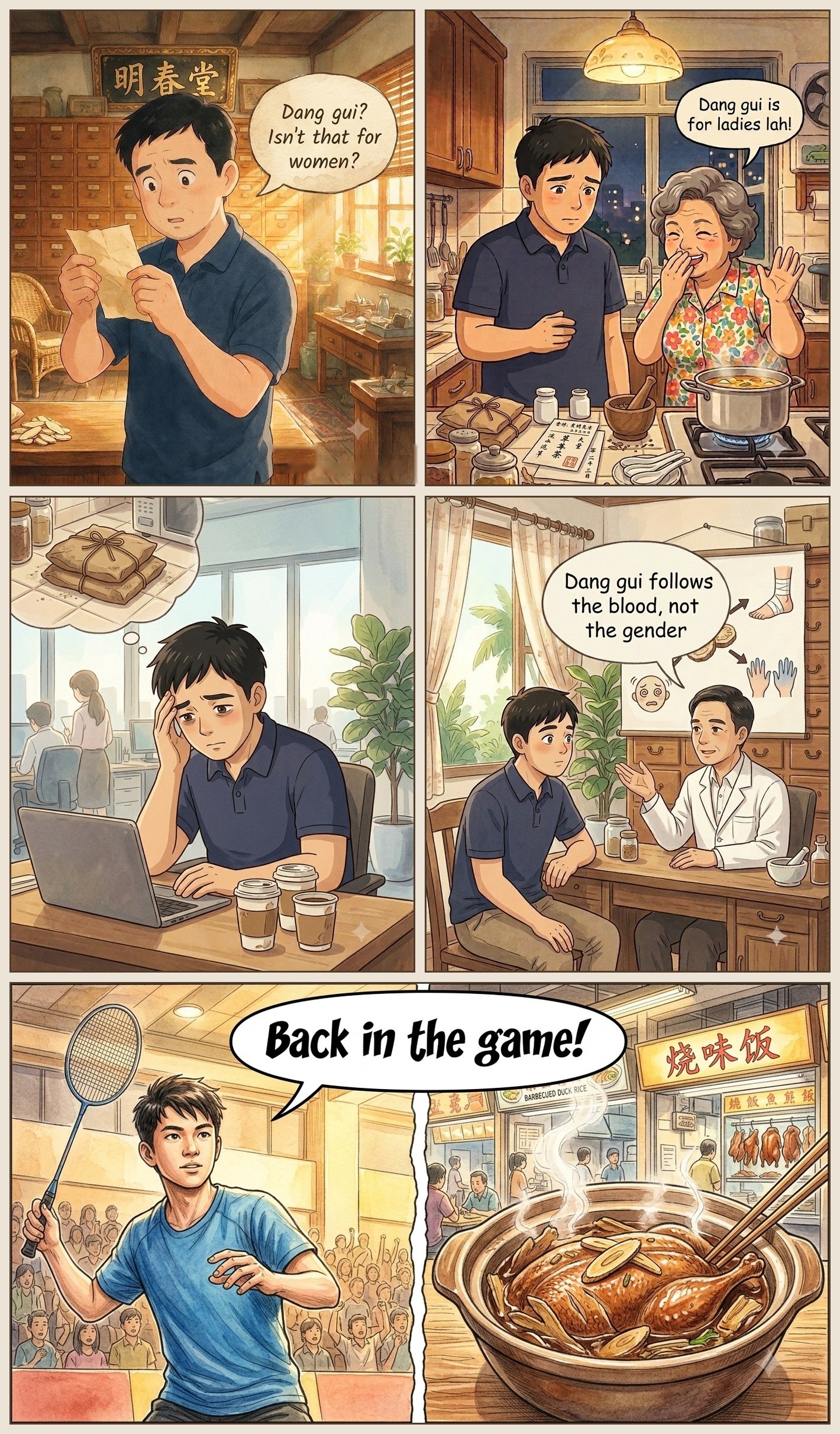
Comic panel generated by seed-dance 2.0 and gemini.
The key point: dang gui follows the blood, not the gender.
In Chinese medicine, dang gui is prescribed for patterns of blood deficiency and blood stasis — nourishing blood (补血) and moving blood (活血). Because menstrual health depends heavily on healthy blood, dang gui appears in many gynaecological formulas, which is how it earned its reputation. But blood deficiency doesn't check your gender. Men recovering from injury or surgery, people with persistent pallor, dizziness, fatigue, or perpetually cold hands and feet — these are all classic blood-pattern presentations, and dang gui serves them equally well.
The classics themselves settle the argument. Dang-gui sits at the heart of 补中益气汤 (Bu Zhong Yi Qi Tang), composed by the Jin-dynasty master physician 李东垣 — the most widely used qi-tonifying formula in Chinese medicine, prescribed to men and women alike for some 800 years. Its role there: to nourish blood as the foundation for lifting qi. If dang gui were truly "for women only," the most famous formula in the canon would make no sense.
Walk through any hawker centre and you'll see we already know this — nobody asks whether 当归鸭 (dang gui duck) is from the ladies' menu.
What you should do: if an ingredient in your prescription puzzles you, don't quietly shelf the packets — ask your physician. That conversation is part of the medicine. TCM prescribes to your pattern (辨证), assessed through consultation, not to your gender and not to hearsay. And the reverse applies too: don't self-prescribe dang gui because you read it's good for blood. The right herb in the wrong pattern is not a tonic.
Herbs don't have genders. Patterns have treatments.
Original article from linkedin here.
This article is for health education only and is not a substitute for consultation with a registered TCM physician.